When modern history textbooks chronicle the American War for Independence, the narrative is overwhelmingly dominated by political philosophy, military tactics, and economic grievances. We read endlessly of tax acts, troop movements, and the strategic maneuvers of generals. While these elements are undoubtedly crucial, this secularized lens often completely omits the profound spiritual engine that drove the colonial resistance.
To look at the American Revolution without examining its deeply rooted religious conviction is to read only half the story. The struggle for independence was not merely a political rebellion against a king; to the everyday men and women who endured it, it was a defense of God-given liberty. As the nation approaches its landmark 250th anniversary, reclaiming this untold spiritual history is vital to understanding the true soul of America.
The Pulpit as the Crucible of Freedom
Long before the First Continental Congress ever met in Philadelphia, the philosophical foundation for American liberty was being laid on Sunday mornings from the pulpits of the colonies. Historians often refer to the colonial clergy as the “Black Robe Regiment”—a name given to them by the British, who recognized that the pastors were among the most effective instigators of the liberty movement.
These ministers did not preach a gospel of passive submission to tyranny. Instead, drawing heavily from old-world history and biblical loops of justice, they argued that absolute power belonged to God alone. Therefore, when a earthly monarch violated the natural rights of his subjects, resistance became a moral and spiritual duty.
Pastors like Jonas Clark of Lexington and John Witherspoon (the only active minister to sign the Declaration of Independence) framed the conflict not as a lawless revolt, but as a righteous stand for the preservation of sacred covenants. They taught their congregations that civil liberty and religious liberty were inextricably linked; if one fell, the other would inevitably perish.
Devotion in the Ranks of the Continental Army
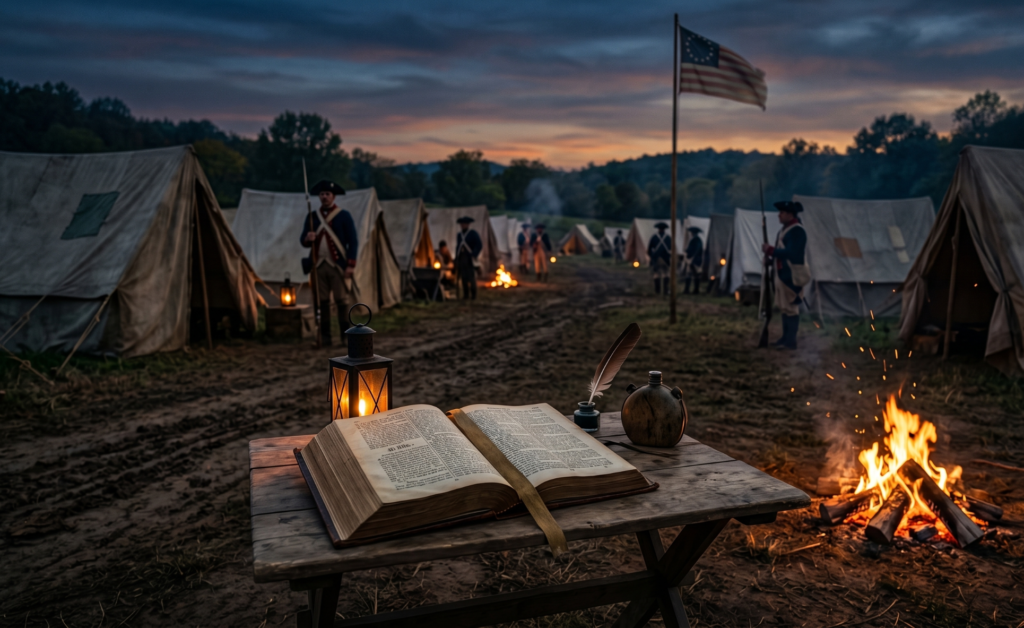
For the average soldier marching in the Continental Army, faith was not a casual abstraction—it was a survival mechanism. The conditions endured by these men were notoriously horrific. Short on rations, lacking adequate footwear, and facing the most powerful military empire on earth, what kept the army from completely fracturing during the brutal winters of Valley Forge and Morristown?
The answer lives in the deeply ingrained spiritual life of the camps. General George Washington, a man of profound personal faith, recognized from the very beginning of his command that a moral army was a resilient army. In his general orders, Washington strictly prohibited profanity, gambling, and drunkenness, while passionately mandating regular divine services for his troops.
Washington firmly believed that the American cause could not succeed without the favor of heaven. He appointed chaplains to every regiment, representing various denominations, ensuring that soldiers had access to spiritual counsel and communal worship. Amidst the freezing snow and disease-ridden huts, the sound of traditional hymns frequently echoed through the camps, providing a rhythmic, comforting reminder of the higher purpose behind their suffering.
The Doctrine of Divine Providence
If there is one phrase that dominates the personal diaries, letters, and public declarations of the Revolutionary generation, it is “Divine Providence.” This was not a generic term for luck; it was a specific, robust theological belief that God was actively intervening in human history to guide and protect the young nation.
Time and again, both leaders and common soldiers witnessed events that they could only describe as miraculous interventions. One of the most famous occurred during the Battle of Long Island in August 1776. Washington’s forces were completely surrounded by the British and faced total annihilation. Under the cover of darkness, Washington executed a daring evacuation across the East River.
As the sun began to rise, thousands of American troops were still exposed and waiting to cross. Miraculously, an incredibly dense, unnatural fog rolled in over the river, completely obscuring the American retreat from British eyes until the very last boat had safely departed. Throughout his life, Washington pointed back to moments like this fog, openly declaring that the hand of Providence was clearly visible in the preservation of the army.
A Legacy for the 250th Anniversary
The American Revolution succeeded against all mathematical and military odds. It succeeded because it was fueled by a generation that genuinely believed their struggle was aligned with eternal truths. They believed that freedom was worth sacrificing their lives, their fortunes, and their sacred honor because freedom did not belong to King George—it belonged to the Creator.
As we look toward the 250th anniversary of our nation, the challenge for modern Americans is to look past the surface-level politics and remember the deep spiritual bedrock upon which this country was built. The story of the Revolution is a lasting testament to the fact that when a people’s faith is forged in the fire of adversity, they can stand against any empire on earth.