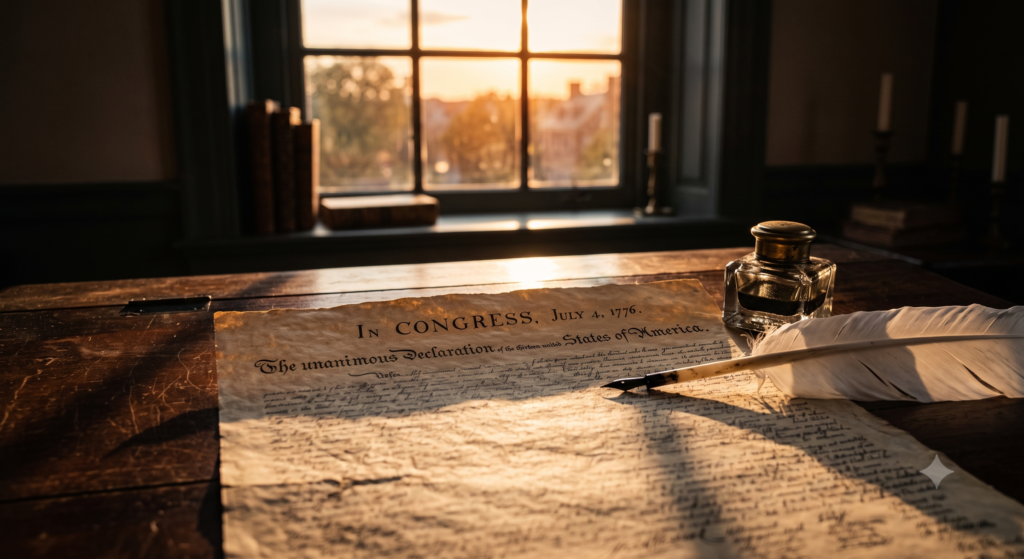
When modern citizens think of America’s founding document, their minds instantly fly to the celebratory fireworks of the Fourth of July. We envision the final, polished parchment signed by bold men risking the gallows. Yet, the true spiritual and intellectual battle for the birth of the republic reached its absolute crescendo during the final weeks of June 1776.
During these intense summer days in Philadelphia, a chosen Committee of Five—led by a young Thomas Jefferson—worked in absolute isolation to frame a document that would change human history. They were not merely drafting a legal brief to dissolve a political union; they were executing a profound moral statement. To understand the true soul of America as we cross its historic 250th anniversary, we must look at how the Declaration of Independence was intentionally structured as a sacred covenant of liberty.
The Seventeen Days of Divine Inspiration
Between June 11 and June 28, 1776, Jefferson locked himself away on the second floor of a private home on Market Street. Armed with a portable writing desk and a deep reverence for natural law, he labored over the specific language that would justify an open break with the British Empire.
Jefferson was well aware that human history was littered with lawless rebellions driven by bloodlust or a simple desire for power. The American experiment had to be entirely different. To command the respect of the world, it needed a foundational anchor that transcended the fickle whims of kings, parliaments, or human governments.
When Jefferson presented his rough draft to the Continental Congress on June 28, 1776, the opening lines established a paradigm shift that sent shockwaves through the old world. Rights were no longer defined as privileges granted by a benevolent monarch. Instead, the document boldly claimed that civil liberties were the absolute property of the individual, derived directly from the laws of nature and of nature’s God.
Framing Liberty as an Unalienable Gift
The theological brilliance of the Declaration lives in its explicit reliance on a higher authority. By declaring that all men are “endowed by their Creator with certain unalienable Rights,” the Founders placed American freedom entirely out of the reach of human tyranny.
This specific wording was a deliberate structural shield. The logic was completely airtight: if human rulers did not grant your rights, human rulers had absolutely no authority to strip them away. By anchoring human dignity in the divine, the Continental Congress elevated a political dispute over taxes into a cosmic stand for universal justice.
When delegates debated the wording during the final days of June, they did not dilute this spiritual foundation. Instead, they reinforced it. They openly acknowledged that the success of the fragile, young republic would depend entirely on the protection of Divine Providence, binding themselves to one another under the eyes of heaven.
The Mutual Pledge of Sacred Honor
A covenant is vastly different from a standard political contract. A contract is built on mutual suspicion and legal loopholes; a covenant is a sacred bond sealed by an oath of honor. The closing lines of the Declaration beautifully reflect this covenantal reality, stating that for the support of the declaration, the signers “mutually pledge to each other our Lives, our Fortunes and our sacred Honor.”
This was not empty, poetic rhetoric. Every single man who stepped forward to ink his name onto that parchment was signing his own death warrant if the Revolution failed. They knew the British crown viewed them as traitors deserving of the noose. Yet, their conviction in the righteousness of the cause superseded their fear of death.
They sacrificed their massive estates, watched their homes burn, and sent their sons into brutal battles because they genuinely believed they were passing down a sacred inheritance of freedom to future generations. They understood that liberty was a gift from God, but its preservation required the ultimate human sacrifice.
Honoring the Covenant at 250 Years
As our nation observes its monumental 250th anniversary milestone, the story of late June 1776 serves as a powerful mirror for modern America. The liberties we enjoy today are not standard political guarantees; they are the fruits of a sacred covenant forged by men of deep conviction and unyielding faith.
Reclaiming our history means moving past superficial celebrations and rededicating ourselves to the timeless truths penned on that Philadelphia parchment. The covenant of liberty still requires our vigilance, our honor, and our unwavering faith to ensure that a government of the people, by the people, and for the people continues to shine as a beacon of freedom to the entire world.