A Missing Piece of History
When modern history textbooks recount the American Revolution, they frequently focus on the tactical maneuvers of George Washington. They highlight the economic frustrations over British taxation and the political philosophy debated in colonial assemblies. While these factors were undoubtedly critical, a massive piece of the historical puzzle is often left on the cutting room floor. This missing piece is the profound, foundational role of faith and corporate prayer.
The brave men and women who risked their lives, fortunes, and sacred honor to birth the United States did not view their struggle through a purely secular lens. On the contrary, they believed that the fight for liberty was inherently intertwined with their spiritual convictions.
The Continental Congress and the First Prayer
In September 1774, when delegates from the various colonies met in Philadelphia for the First Continental Congress, the atmosphere was thick with anxiety. British troops had occupied Boston, and the threat of total war loomed large. Therefore, Thomas Cushing, a delegate from Massachusetts, suggested that the session open with a prayer. Some delegates objected, arguing that because the room was comprised of Anglicans, Puritans, Presbyterians, and Quakers, they were too divided religiously to pray together.
However, Samuel Adams rose and boldly stated that he was no bigot and could easily hear a prayer from any gentleman of piety and virtue who loved his country. The following morning, Reverend Jacob Duché read the 35th Psalm to the anxious room. He then broke into a spontaneous, fervent prayer for the protection of American liberty. Consequently, John Adams wrote to his wife, Abigail, that the prayer was so moving it brought tears to the eyes of the delegates. It instantly filled the room with a unified sense of divine purpose.
Washington at Valley Forge
Furthermore, General George Washington’s reliance on prayer was a matter of official military policy. Throughout the Revolutionary War, Washington consistently issued general orders commanding his soldiers to attend divine services. He strictly forbade profanity and gambling among the ranks. He firmly believed that the Continental Army could not hope for military victory without securing the favor of Divine Providence.
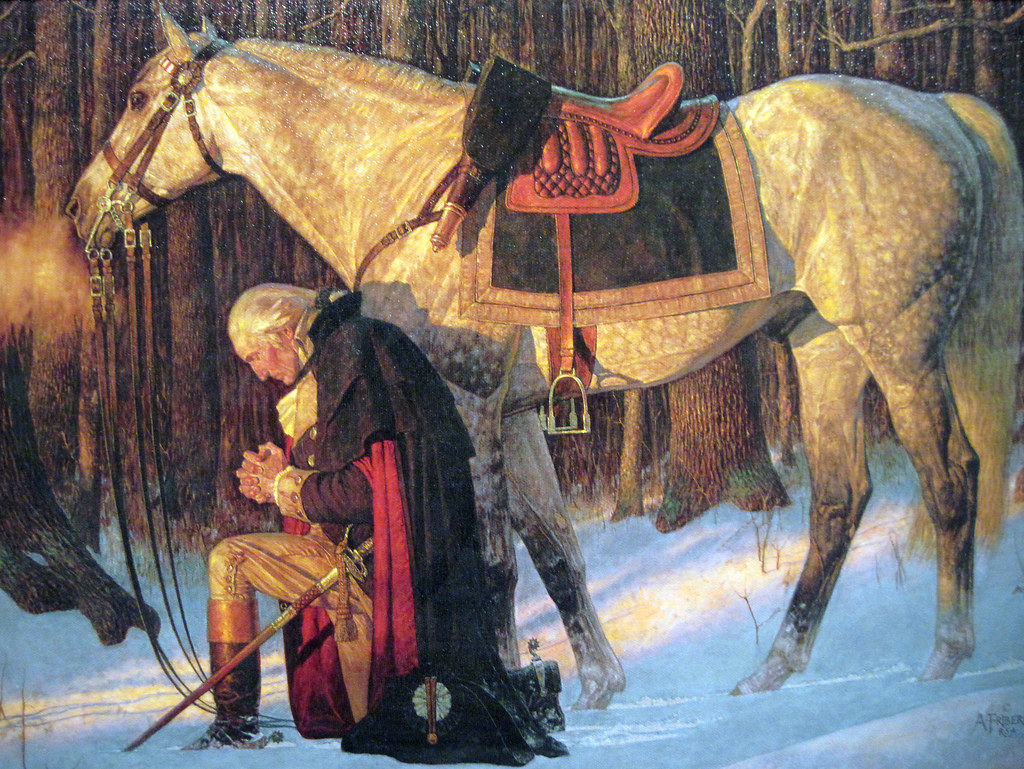
During the brutal winter at Valley Forge in 1777, the army was starving, freezing, and plagued by disease. Eyewitness accounts described Washington retreating into the snow-covered woods completely alone to pray. Whether standing before a desperate army or leading a fragile new government, Washington openly modeled the belief that human leadership is utterly insufficient without divine guidance.
Benjamin Franklin’s Call to Prayer
Perhaps the most striking historical example of faith intersecting with American statecraft occurred during the Constitutional Convention of 1787. For weeks, the delegates were locked in bitter arguments and were unable to agree on how to structure the new government. The convention was on the brink of complete collapse. It was then that 81-year-old Benjamin Franklin stood to address the assembly. He reminded the room of the small, desperate prayers they had offered in that very room during the war, and how those prayers were directly answered. Franklin famously stated:
“I have lived, Sir, a long time, and the longer I live, the more convincing proofs I see of this truth—that God Governs in the affairs of men. And if a sparrow cannot fall to the ground without His notice, is it probable that an empire can rise without His aid?”
Consequently, his motion broke the political gridlock. The delegates quickly found common ground, and the United States Constitution was successfully drafted.
The 250-Year Legacy
As we approach the historic 250th anniversary of our nation, the historical record remains entirely clear. The American experiment was not built on a rejection of faith, but on an unprecedented reliance upon it. The Founders recognized that human rights are secure only when they are understood to be granted by God, not by the government.
To see how other early patriots relied on this exact foundation of faith to stand up for their rights, you can read about the story of The Minutemen. By remembering the prayers that built America, modern communities can find the unity and moral courage needed to face the challenges of our own era. Let us celebrate 250 years of freedom by backing vital community initiatives like Savior City to rebuild America from the ground up.